
What You Are Looking for Is Where You Are Looking From
“She just has a short attention span.”
“He’s impulsive.”
“She’s anxious.”
“That’s just how his brain works.”
We say these things easily.
They feel natural.
They feel descriptive.
But they carry an assumption we rarely stop to examine
that these qualities are things a person simply has.
Stable properties.
Fixed features.
Enduring facts about who someone is.
That assumption is understandable.
People do repeat patterns.
A child may regularly struggle to sit still,
to sustain attention,
to tolerate frustration,
or to manage emotion.
An adult may predictably avoid conflict,
lose track of tasks, overreact under pressure,
or feel overwhelmed by ordinary demands.
Over time, what repeats becomes familiar.
What is familiar becomes predictable.
And what is predictable starts to feel permanent.
So we name it.
Attention deficit. Anxiety. Rigidity. Sensitivity. Impulsivity.
Sometimes that language helps.
Sometimes it is necessary.
But it can also hide something important.
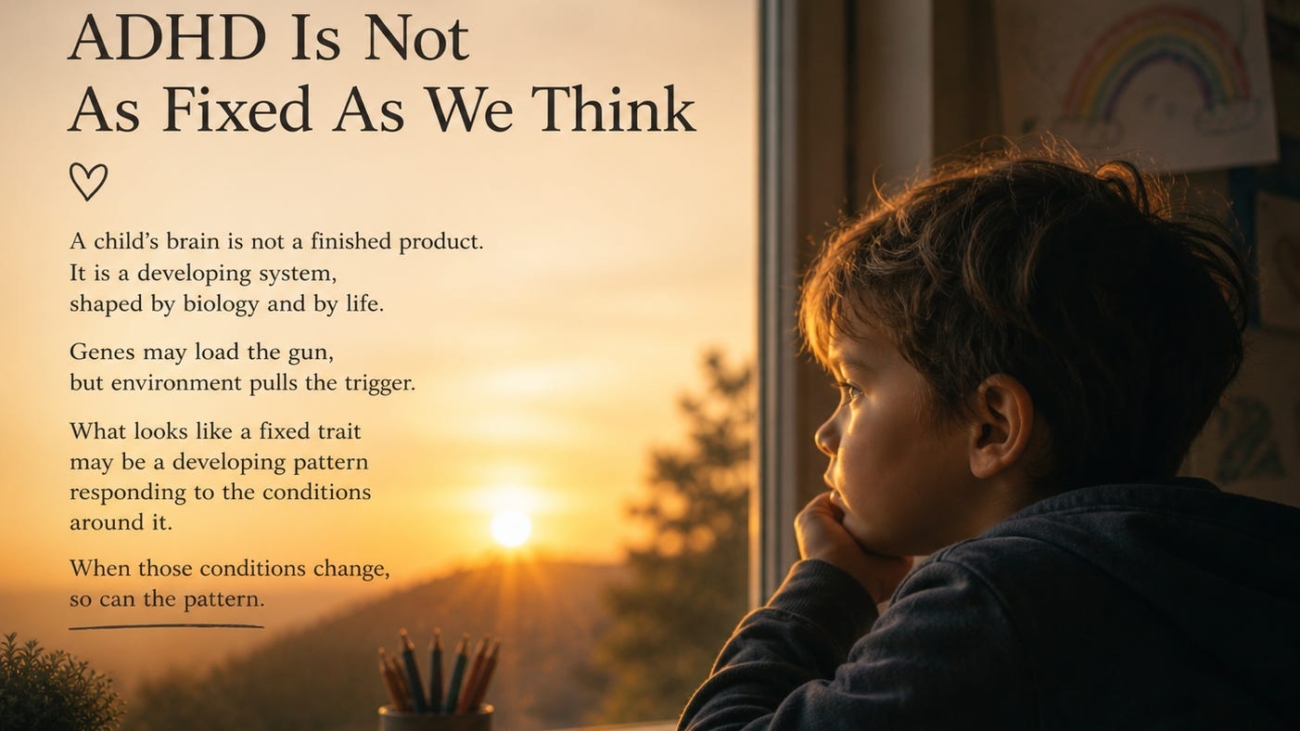
The same person is not the same under all conditions.
A child who cannot focus in one classroom may become completely absorbed in play.
A child who is volatile at the end of a long day may be calm and flexible the next morning.
A child who seems inattentive during schoolwork may concentrate for hours on something that fully engages them.
The difficulty is real.
But it is not always expressed in the same way, in every setting, at the same strength.
It appears. It fades. It intensifies. It softens.
Once you notice that, what looked fixed begins to look more conditional.
This is where the frame needs to shift.
What we call traits are often not best understood as things we permanently…

Add a Comment
You must be logged in to post a comment